Breakthrough in Dark Matter Research at Berkeley Lab
Scientists at Berkeley Lab's LUX-ZEPLIN experiment may have made significant progress in detecting dark matter, a mysterious substance that constitutes a major part of the universe's mass.
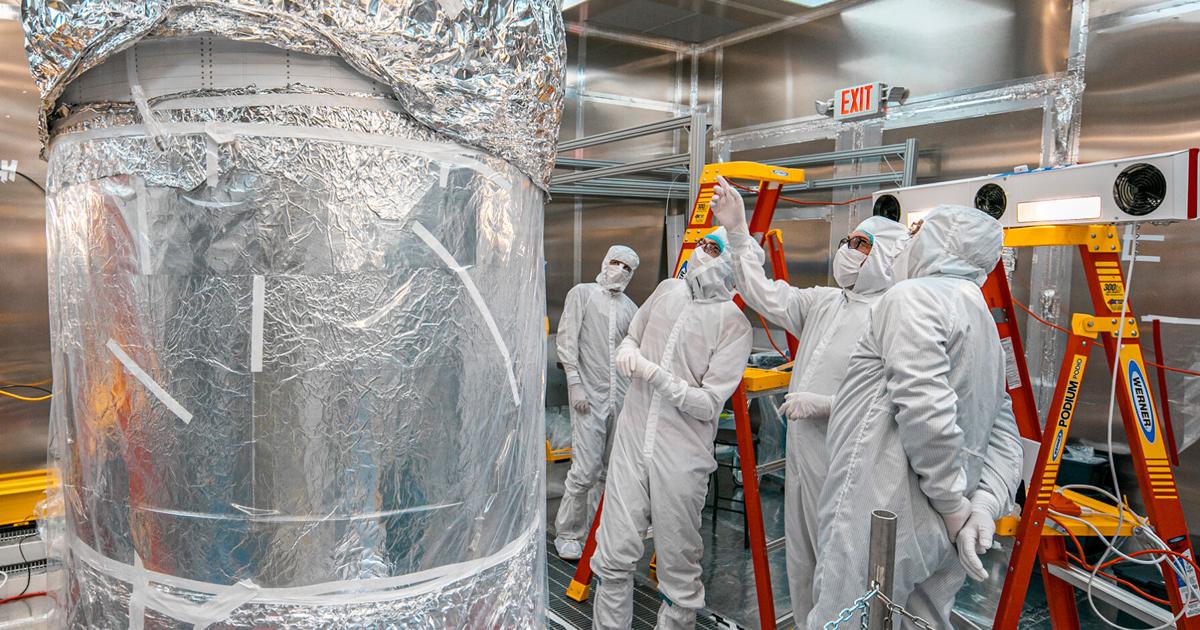
LUX-ZEPLIN experiment aims to directly detect dark matter for the first time.
Recent data suggests a potential breakthrough in understanding dark matter interactions.
The experiment utilizes a unique setup nearly a mile underground in South Dakota.
In a groundbreaking development, researchers at Berkeley Lab's LUX-ZEPLIN (LZ) experiment have reported promising findings in their quest to detect dark matter, an elusive substance believed to make up over 85% of the universe's mass. The experiment, located nearly a mile underground in South Dakota, recorded a significant event involving a collision that emitted light, potentially indicating dark matter interactions.
The LUX-ZEPLIN experiment, which began data collection in 2021, is a collaboration merging two previous dark matter projects: Large Underground Xenon (LUX) and ZonEd Proportional scintillation in LIquid Noble gases (ZEPLIN). The facility utilizes a cylindrical chamber filled with 10 tons of ultrapure liquid xenon, cooled to extreme temperatures to enhance detection capabilities. Researchers believe that the unique properties of xenon, particularly its large nucleus, make it an ideal candidate for identifying dark matter particles, known as WIMPs (Weakly Interacting Massive Particles).
Recent analyses of data collected over 220 days from March 2023 to April 2024 have revealed intriguing results, including a notable event on June 16, 2023, where a xenon nucleus was struck with energy indicative of a potential dark matter interaction. According to Aaron Manalaysay, a staff scientist involved in the LZ experiment, this could represent a significant step toward understanding the fundamental nature of dark matter and its role in the universe.
The implications of successfully detecting dark matter extend beyond academic curiosity; they could reshape our understanding of physics. Current models fail to fully explain the behavior of galaxies, which rotate faster than expected based on visible matter alone. If dark matter is confirmed, it could provide answers to these anomalies and lead to new theories in physics, challenging existing paradigms.
Looking ahead, the LUX-ZEPLIN team is set to continue their data collection and analysis, with hopes of further clarifying the nature of dark matter. Future results could unveil new insights into the fundamental forces shaping our universe, making this a critical period for astrophysics and particle physics alike.


