NASA's Webb Telescope Unveils New Insights into Lion Nebula
The James Webb Space Telescope has provided a detailed view of the Lion Nebula, highlighting its unique structure and the remnants of a dying star.
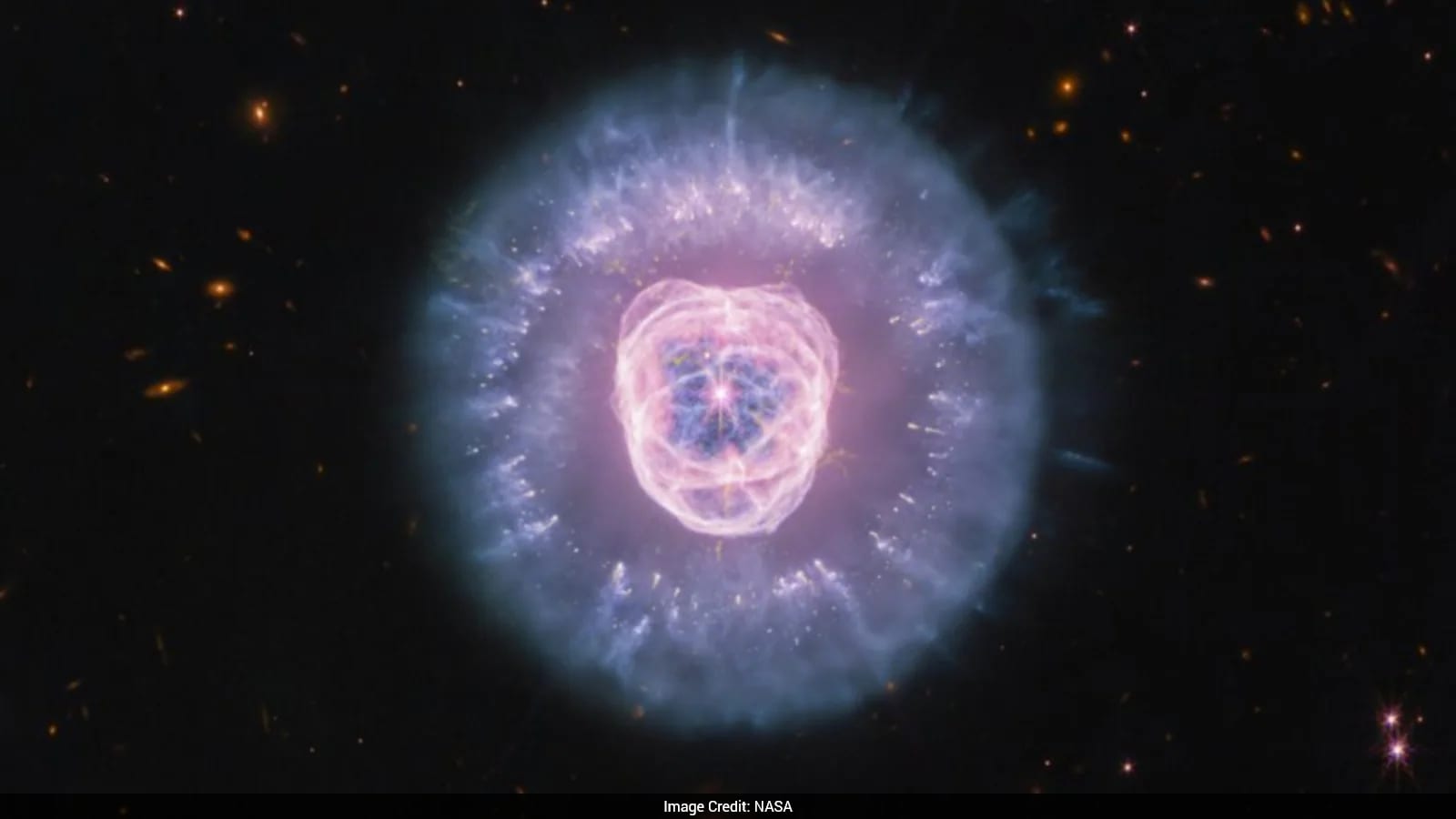
NASA's Webb Telescope captures detailed images of the Lion Nebula.
The nebula's center features a white dwarf star, remnants of a dying star.
Webb's infrared technology reveals intricate structures not visible in previous observations.
NASA's James Webb Space Telescope has recently provided an enhanced view of the Lion Nebula, also known as NGC 2392, showcasing its distinctive shape and the dying star at its core. This new imagery reveals significant details that were not visible in earlier observations made by the Hubble Space Telescope in 2000, which first identified the nebula's lion-like appearance and its 'mane' composed of comet-like objects.
The Webb Telescope utilized its advanced Near Infrared Camera (NIRCam) and Mid-Infrared Instrument (MIRI) to capture these detailed images. While the overall structure of the nebula bears resemblance to Hubble's visible-light images, Webb's infrared capabilities have unveiled small clumps of dust and ionized gas that were previously obscured. This enhanced clarity allows scientists to observe the ongoing changes in the nebula, which have been occurring over thousands of years.
At the heart of the Lion Nebula lies the remnants of a dying star, which resembles a lion's 'button nose.' This star, unlike massive stars that end their lives in explosive supernovae, undergoes a different process. When it can no longer sustain nuclear fusion in its core, it becomes unstable, pulsates, and sheds its outer layers, forming a planetary nebula. The radiation from this dying star pushes the surrounding material outward, resulting in the formation of an extremely hot core known as a white dwarf.
The white dwarf at the center of the Lion Nebula is the remnant of an oxygen-rich star that has passed away. It continues to influence its environment by heating the surrounding material, creating a bubble of ionized gas that contributes to the nebula's lion-like appearance. This bubble is gradually expanding, eroding the dust in its vicinity. The complex rings and shells formed by the gas are common in planetary nebulae, but understanding their detailed structures remains a significant area of ongoing research.
As scientists analyze the data from Webb, they hope to gain further insights into the life cycles of stars and the evolution of nebulae. The findings from the Lion Nebula could provide valuable information about similar celestial phenomena across the universe, enhancing our understanding of stellar evolution and the cosmos.


