Gemini 3.5 Transcribe Launches with Enhanced Features on August 26, 2026
Google's Gemini 3.5 Transcribe and OpenAI's GPT-Transcribe released within weeks of each other, showcasing significant advancements in transcription technology.
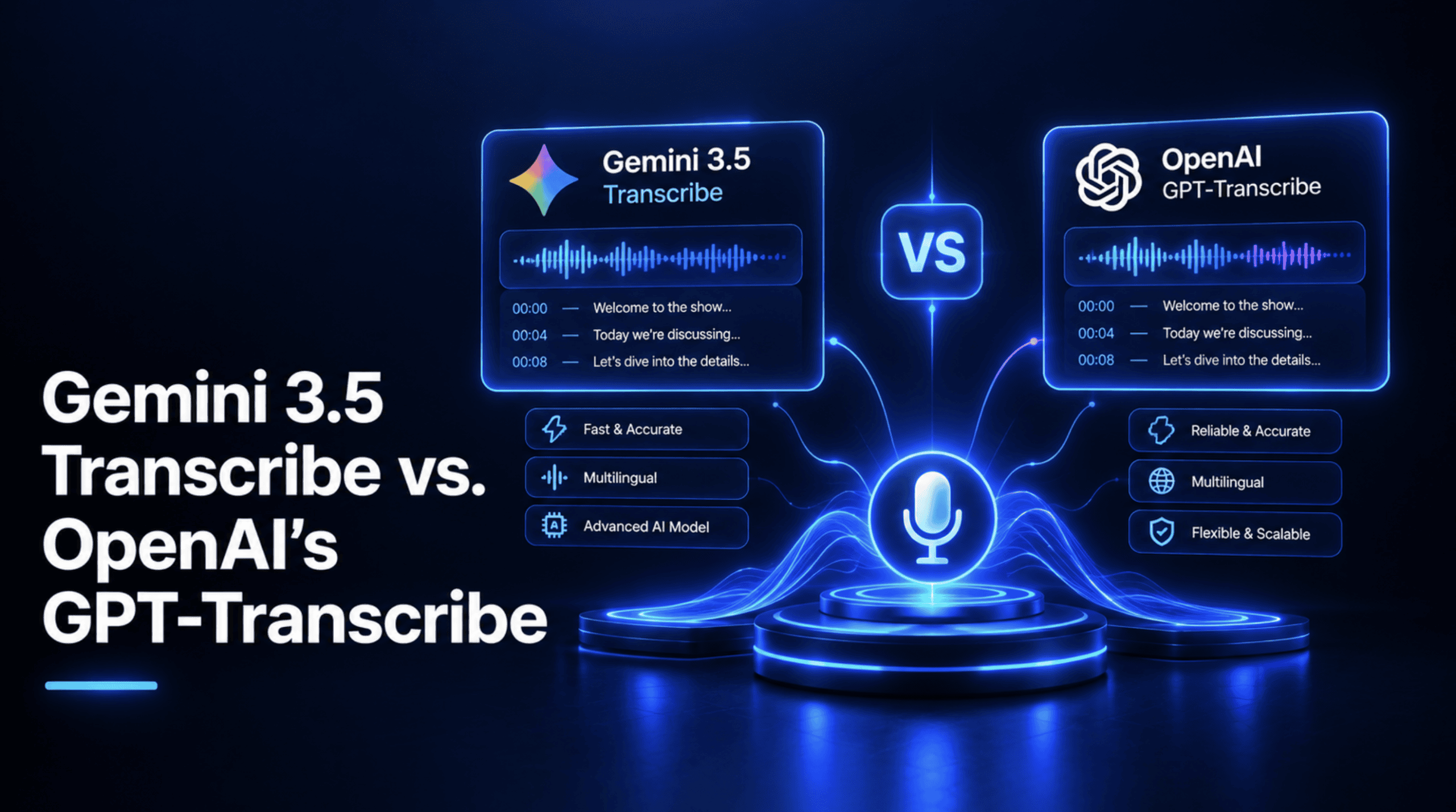
Gemini 3.5 Transcribe offers a 70% improvement in transcription speed over its predecessor.
OpenAI's GPT-Transcribe reduces word error rates significantly, achieving 19.27% on Common Voice.
Both models cater to different needs: Gemini excels in multi-speaker scenarios, while GPT-Transcribe is optimized for single-speaker transcription.
On August 26, 2026, Google introduced its latest transcription model, Gemini 3.5 Transcribe, just weeks after OpenAI launched GPT-Transcribe on July 28, 2026. This timing allows for a meaningful comparison between two advanced transcription technologies that have emerged almost simultaneously, each designed to cater to specific use cases in audio transcription.
Gemini 3.5 Transcribe is a successor to Google's previous model, Chirp 3, and boasts a remarkable 70% enhancement in transcription speed. It operates under two distinct model IDs: gemini-3.5-transcribe-live for real-time streaming and gemini-3.5-transcribe for processing pre-recorded audio. The model achieves a word error rate (WER) of 4.0% for streaming and 2.6% for non-streaming applications, with additional capabilities such as multi-speaker attribution and word-level timestamps, supporting over 85 languages.
In contrast, OpenAI's GPT-Transcribe, which follows the gpt-4o-transcribe model, demonstrates significant improvements as well. It has halved the word error rate from its predecessor, Whisper, achieving approximately 19.27% on the Common Voice benchmark across 22 languages. The pricing structure is also competitive, with costs set at $0.0045 per minute for file transcription and $0.017 per minute for streaming audio. However, it lacks built-in speaker diarization and word-level timestamps, requiring additional models for these features.
The implications of these advancements are substantial for various sectors. Gemini 3.5 Transcribe is particularly beneficial for environments where multiple speakers are involved, such as meetings or conferences, enabling clear differentiation between speakers. On the other hand, GPT-Transcribe serves well in scenarios where quick, cost-effective transcription is needed, such as live events or single-speaker recordings.
Looking ahead, both Google and OpenAI are expected to continue refining their transcription technologies. Users can anticipate further enhancements in accuracy and functionality, as well as potential updates to pricing models, making these tools increasingly accessible for diverse applications in the audio processing landscape.