CHIME Detects Ancient Hydrogen Glow, Advancing Dark Energy Research
The Canadian Hydrogen Intensity Mapping Experiment has successfully detected the faint radio signals of hydrogen from billions of years ago, marking a significant advancement in cosmological studies.
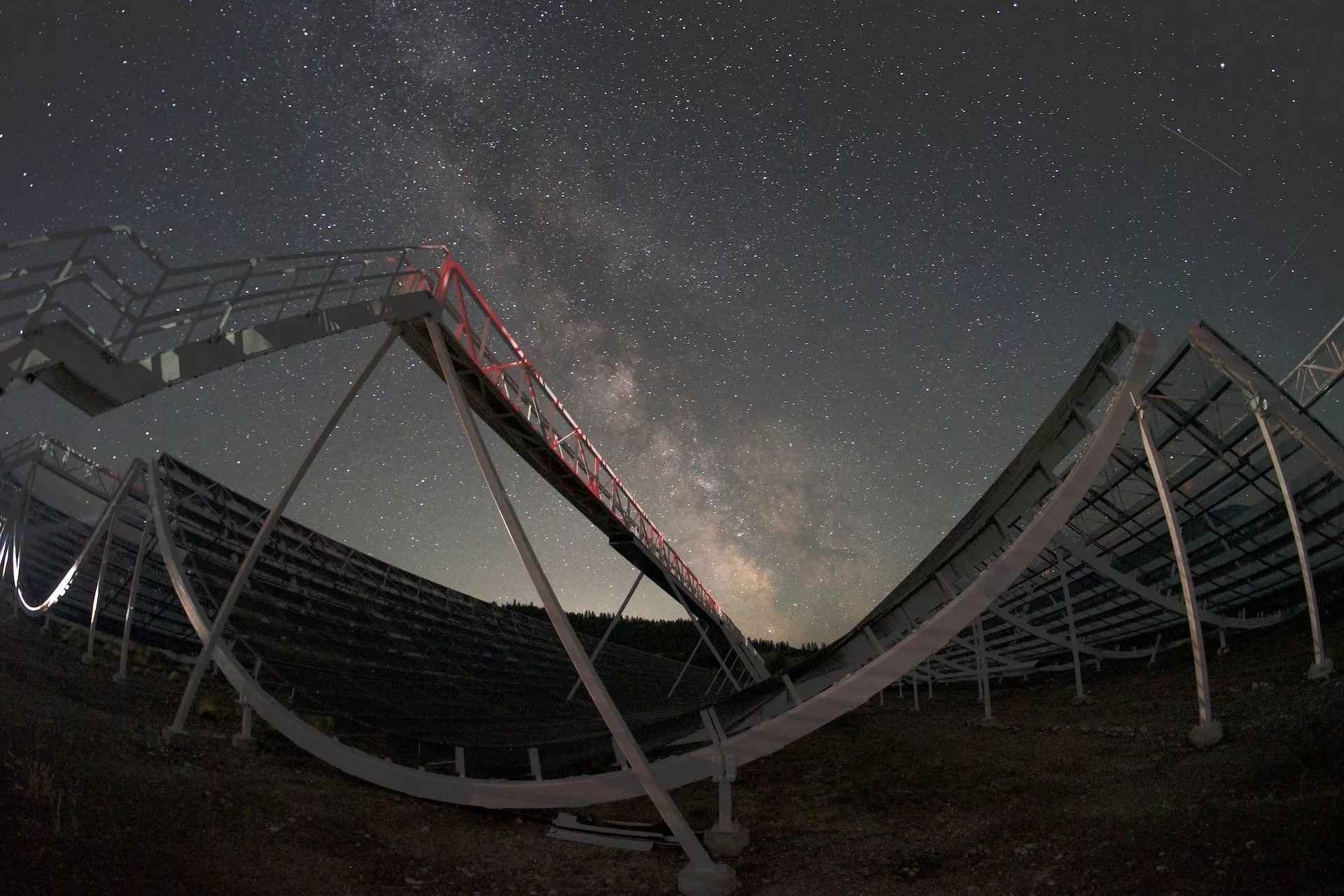
CHIME detected hydrogen signals from five billion years ago, aiding dark energy research.
This method allows for a cost-effective exploration of cosmic history without reliance on visible light.
The findings are based on 94 days of observations, with plans to analyze data from over seven years.
In a groundbreaking achievement, the Canadian Hydrogen Intensity Mapping Experiment (CHIME) has successfully detected the faint radio emissions of hydrogen gas dating back billions of years. This remarkable feat was accomplished in the serene hills near Penticton, British Columbia, utilizing only its own data without assistance from other telescopes. The results, published in The Astrophysical Journal, represent a significant advancement in the field of cosmology, offering a new approach to investigate the universe's expansion and the enigmatic nature of dark energy.
Historically, CHIME has relied on cross-correlating its data with galaxy surveys conducted by other telescopes, which are often limited to regions dense enough to form stars and dependent on visible light. This traditional method can be both costly and restrictive. However, by directly detecting hydrogen, CHIME can explore larger cosmic scales and delve deeper into the universe's past, all while significantly reducing operational costs. Dr. Mark Halpern, CHIME's principal investigator, emphasized that this innovative technique is a bold step forward in global cosmology efforts and highlights Canadian contributions to the field.
The analysis conducted by the CHIME team revealed that approximately two percent of the universe's hydrogen was in neutral atomic form around five billion years ago. This data allows astronomers to better understand the distribution and clustering of hydrogen, which is crucial for testing theories regarding galaxy formation and evolution. Dr. Arnab Chakraborty, a postdoctoral fellow at the University of Toronto, noted that hydrogen acts as a cosmic tracer, revealing how matter is spread across the universe.
Despite the significance of this discovery, isolating the faint hydrogen signal from background noise posed a considerable challenge. Researchers dedicated over a year to testing and confirming the authenticity of the signal, ensuring it was not a false alarm. The findings are based on just 94 days of observations in 2019, but CHIME has been operational since 2016, amassing over seven years of observational data. This extensive dataset will enable researchers to probe even further back in cosmic history, potentially reaching three billion years after the Big Bang.
Looking ahead, CHIME's ongoing observations could provide invaluable insights into dark energy, a phenomenon that has puzzled scientists for decades. The success of CHIME underscores the importance of patience and perseverance in scientific discovery, revealing that many mysteries of the universe remain hidden, waiting to be uncovered through diligent exploration and analysis.