Rogue Black Holes: Cosmic Archivists of Galaxy Histories
New research reveals that wandering black holes may carry the histories of their home galaxies as they drift through space.
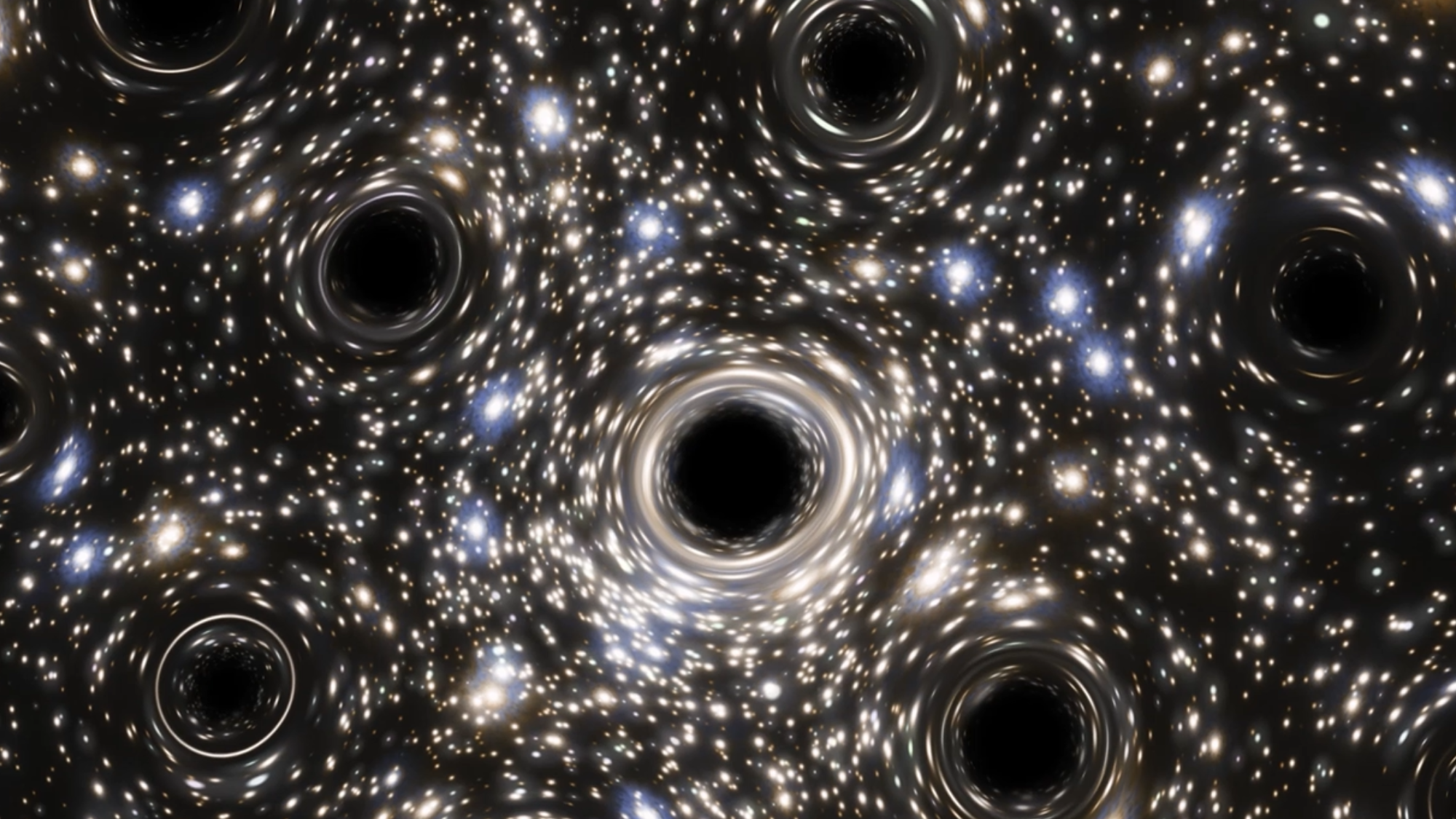
Wandering black holes can retain information about their birth galaxies.
Low-mass galaxies are more likely to host wandering black holes.
The study utilized the ASTRID simulation to model black hole behavior over billions of years.
Recent research indicates that rogue black holes, which drift away from their original galaxies, may serve as cosmic archivists, preserving the histories of their home galaxies. This study, led by Yale University scientists, suggests that these black holes carry significant information about the events that shaped their galaxies over billions of years.
The phenomenon occurs when galaxies collide and merge, displacing black holes from their centers. Smaller galaxies, with weaker gravitational forces, are particularly prone to this displacement, allowing black holes to wander further from their formation sites. While supermassive black holes at the centers of galaxies are known to influence their host galaxies' evolution, this new research highlights the importance of rogue black holes as witnesses to cosmic history.
Emma Jane Weller, the team leader, emphasized the necessity of considering wandering black holes alongside those at galactic centers to fully understand the origins and dynamics of massive black holes. The research also touches on the ongoing debate regarding the formation of black holes, specifically whether they originated from smaller 'light seeds' or larger 'heavy seeds' in the early universe.
Using the ASTRID cosmological simulation, which traces 13.5 billion years of cosmic history, the research team modeled galaxies with masses ranging from 10 million to 1 billion times that of the sun. This simulation allowed for the exploration of black holes that were not confined to the centers of their galaxies, revealing that low-mass galaxies tend to retain information about their initial black hole populations even after extensive cosmic events.
The implications of this research extend beyond theoretical astrophysics, as understanding the behavior of wandering black holes could provide insights into galaxy formation and evolution. The combination of simulation data with various astronomical observations may lead to a deeper understanding of black hole origins. The findings were published on September 7 in The Astrophysical Journal Letters, marking a significant step forward in the study of black holes and their role in the universe.