IISER Bhopal Discovers Time-Reversal Symmetry Breaking in YbSb₂
A groundbreaking study from IISER Bhopal reveals unusual time-reversal behavior in a Type-I superconductor, YbSb₂, challenging existing theories.
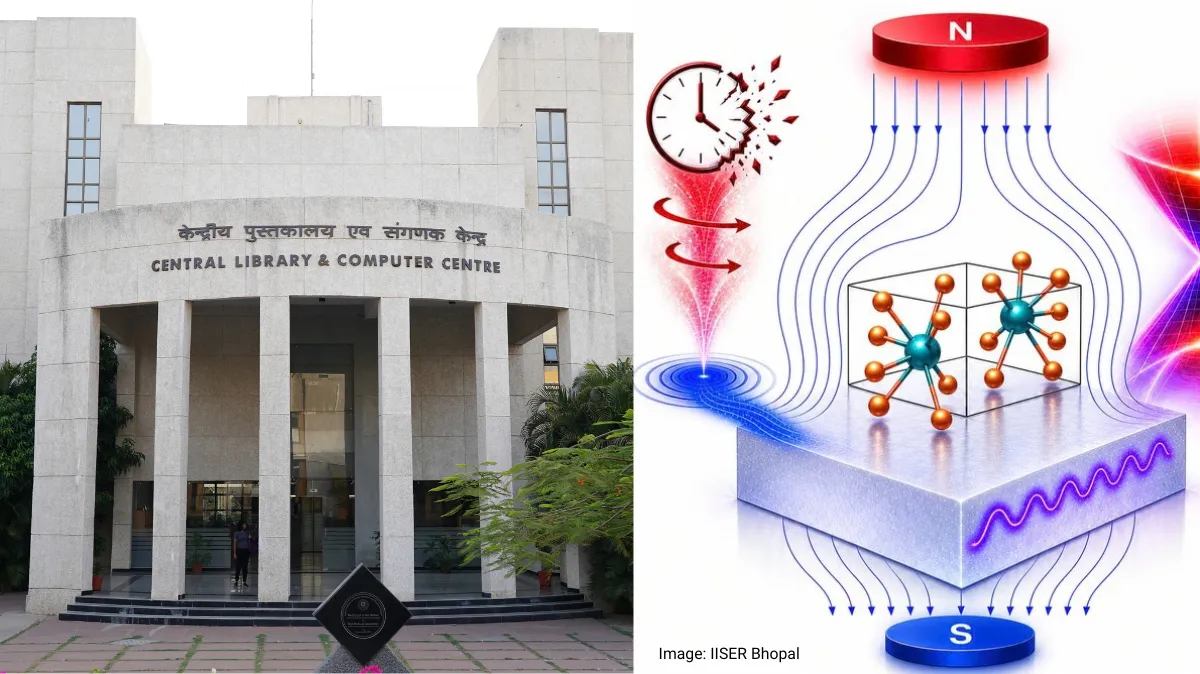
IISER Bhopal researchers found time-reversal symmetry breaking in YbSb₂, a Type-I superconductor.
This discovery could enhance understanding of electron pairing and its implications for quantum computing.
The study suggests potential links between superconductivity, magnetism, and topology.
Researchers at the Indian Institute of Science Education and Research (IISER) Bhopal have made a significant discovery regarding the behavior of a Type-I superconductor, YbSb₂. This study, which highlights the breaking of time-reversal symmetry, marks a notable shift in the understanding of superconducting materials, as such behavior has typically been linked to more complex Type-II superconductors. The findings were published recently and are expected to influence future research in the field.
Time-reversal symmetry in physics implies that the fundamental behavior of a system should remain unchanged if time is reversed. The IISER Bhopal team, in collaboration with researchers from IIT Kanpur and the ISIS Neutron and Muon Source, observed that YbSb₂ generates internal magnetic fields spontaneously when it transitions into its superconducting state. This phenomenon is particularly intriguing as it indicates a break in time-reversal symmetry, a characteristic usually associated with unconventional superconductivity.
The researchers identified YbSb₂ as the first known Type-I superconductor exhibiting this unusual behavior. Their observations suggest that this material could serve as a cleaner platform for studying exotic electron pairing mechanisms and exploring the connections between superconductivity, magnetism, and topological properties. This could lead to advancements in understanding how these factors interplay in superconductors and their potential applications in quantum technologies.
The implications of this discovery extend beyond theoretical physics. By providing insights into the relationship between superconductivity and magnetism, the study may pave the way for new applications in quantum computing, particularly in the investigation of Majorana modes, which are of significant interest for their potential use in fault-tolerant quantum computers. The findings could also inspire further research into other materials that may exhibit similar properties.
Looking ahead, the IISER Bhopal team plans to continue their investigations into YbSb₂ and similar materials. Upcoming studies will focus on understanding the mechanisms behind the observed time-reversal symmetry breaking and exploring the broader implications for superconductivity and quantum state phenomena. This research could redefine the landscape of superconducting materials and their applications in technology.