New Insights on Blazars: X-ray Emissions Unveiled
Recent research reveals new findings about X-ray emissions from blazars, enhancing our understanding of supermassive black holes.
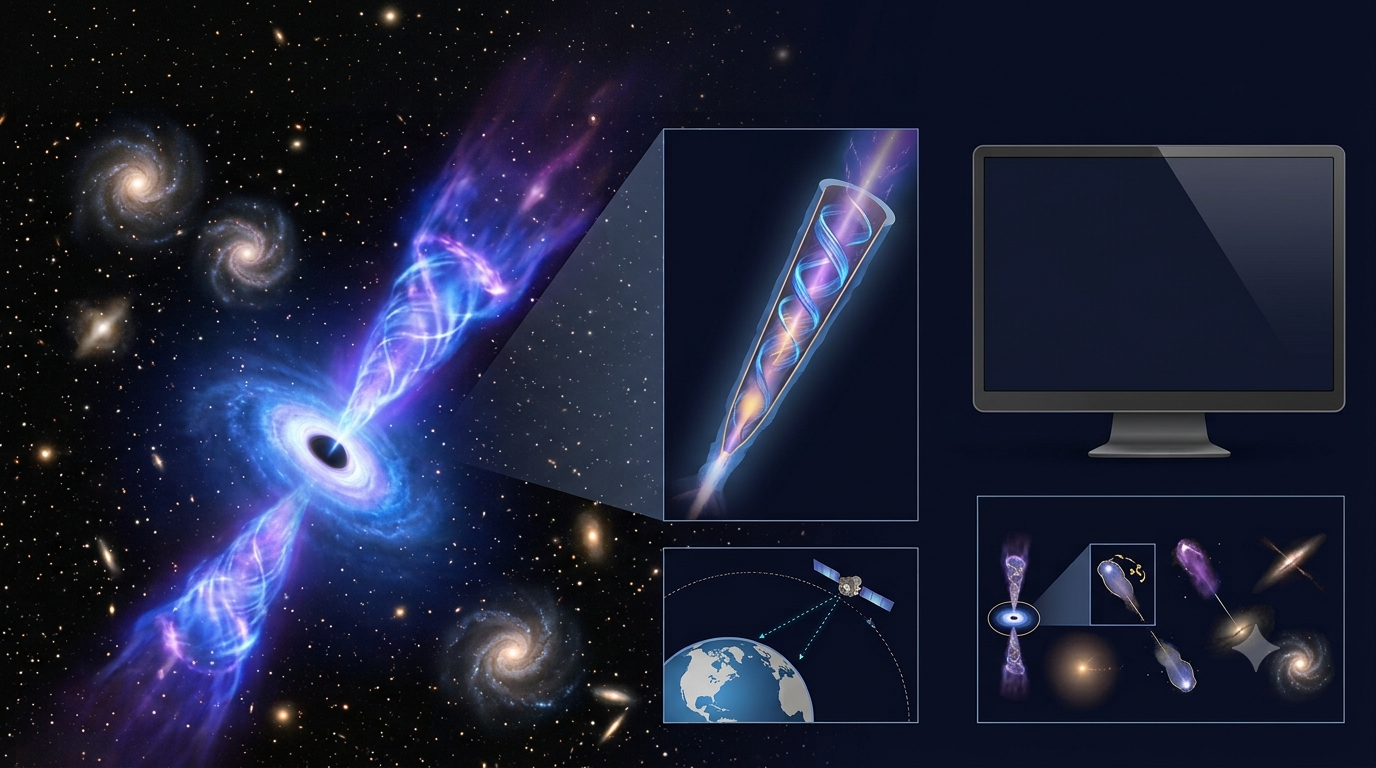
Astronomers studied four TeV blazars to analyze their X-ray emissions.
Observations indicate that weaker jets may allow detection of radiation from the accretion disk.
The study suggests X-ray emissions may originate from multiple sources, not just jets.
Astronomers have made significant strides in understanding the energetic phenomena surrounding blazars, a type of active galaxy powered by supermassive black holes. A recent study conducted by researchers from the Aryabhatta Research Institute of Observational Sciences (ARIES) in Nainital focused on four classical TeV blazars: Mrk 421, Mrk 501, PG 1553+113, and PKS 2155-304. Utilizing data from NASA’s NICER and NuSTAR space telescopes, the team aimed to decipher the mechanisms behind the X-ray emissions from these powerful cosmic entities.
Blazars are characterized by their extreme brightness, attributed to the energy released as matter spirals into the black hole at their center. This process generates powerful jets of relativistic particles that are directed towards Earth, making blazars some of the brightest objects in the universe. The specific class of TeV blazars is known for producing gamma rays with tera-electron volt energies. However, the intense jet emissions often overshadow other radiation sources, complicating the detection of signals from the accretion disk surrounding the black hole.
The research team analyzed 13 sets of X-ray observations, combining data from NICER, which focuses on lower energy emissions, and NuSTAR, which captures higher energy ranges. While the majority of the X-ray spectra aligned with the established model of blazar emissions, intriguing findings emerged from Mrk 421 and Mrk 501, which exhibited additional components at lower X-ray energies during periods of moderate to low activity. This suggests that when the jets weaken, radiation from the accretion disk may become more detectable.
The observations also revealed a small Gaussian feature in the X-ray emissions of Mrk 421, although its exact origin remains uncertain. In contrast, the emissions from PG 1553+113 and PKS 2155-304 were consistent with the standard model, with their curved X-ray spectra indicating variations in particle energy gain and loss rates.
Published in The Astrophysical Journal, this study sheds light on the complex nature of X-ray emissions from blazars, proposing that these emissions may not solely originate from jet activity. The researchers advocate for further observations during both active and quiet phases of blazars to deepen understanding of the contributions from both jets and accretion flows. Future studies utilizing diverse telescopes could clarify the role of the accretion disk in X-ray emissions, enhancing our comprehension of supermassive black holes and their environments.